01
People can’t call for help
Trapped families, the elderly and patients cannot call, text or share their location.
When cyclones and floods take down mobile towers, MeshAlive carries an SOS phone to phone and through rescue boats to the district control room, and brings the answer back.
Every cyclone and flood season, districts lose mobile coverage for hours or days, as in the 2015 Chennai floods and Cyclone Michaung in 2023. That happens in the hours when people most need help.
Trapped families, the elderly and patients cannot call, text or share their location.
No view of who needs help, where they are, how many people, or how urgent.
They don’t reach rescuers or prioritise, and they drain the phones that relay for others.
An Android app and a browser-based district dashboard. No towers, no internet, no extra hardware.
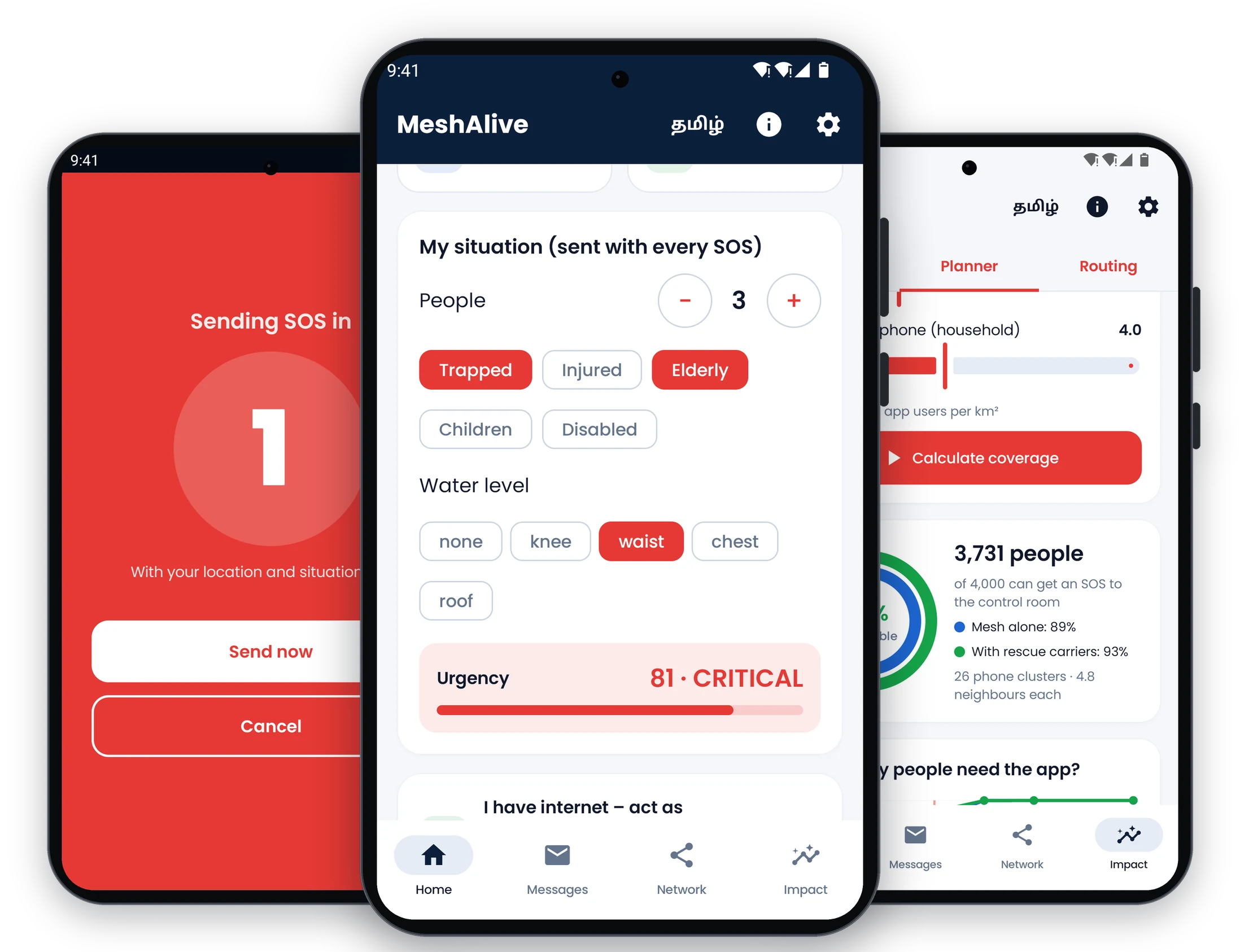
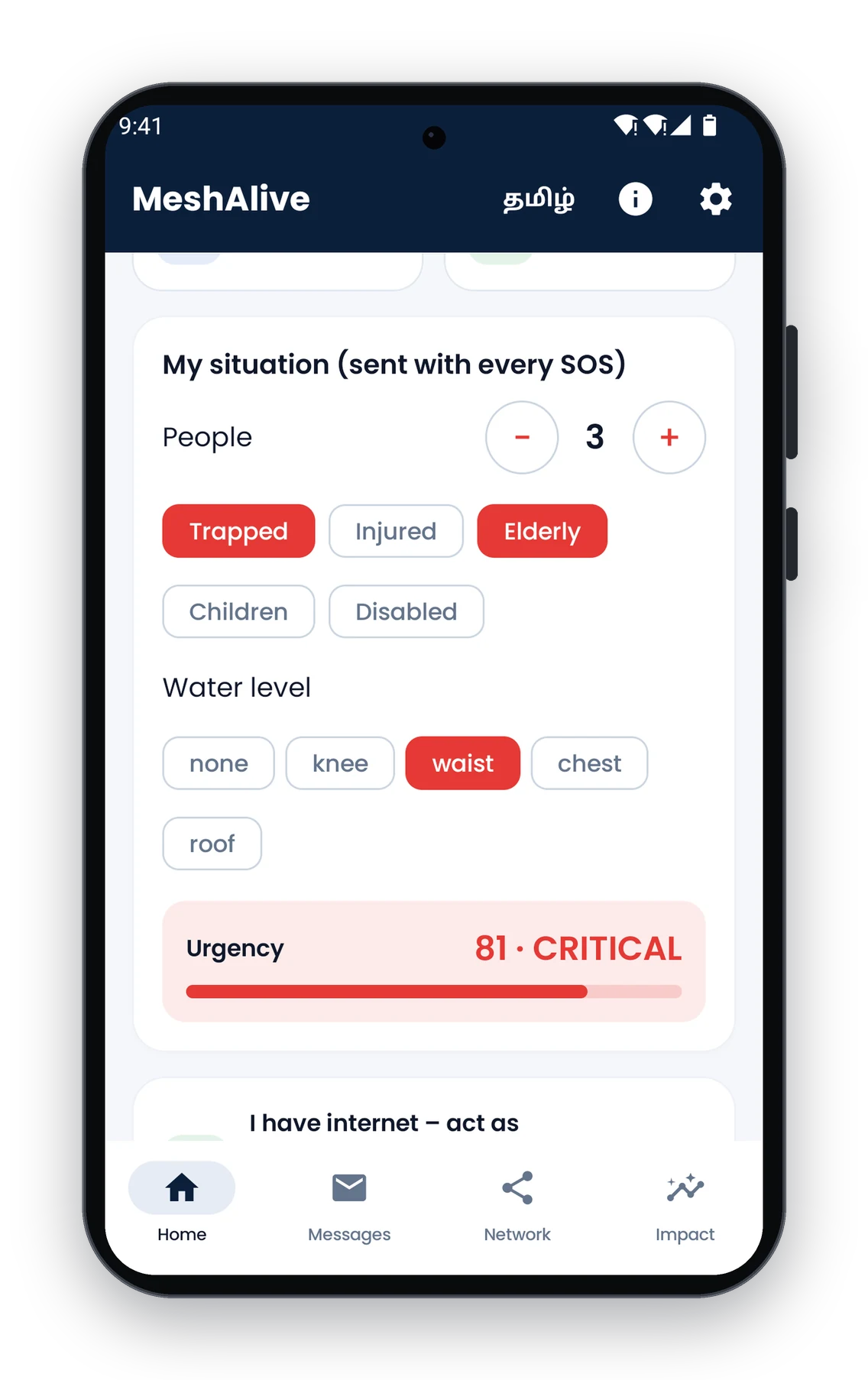
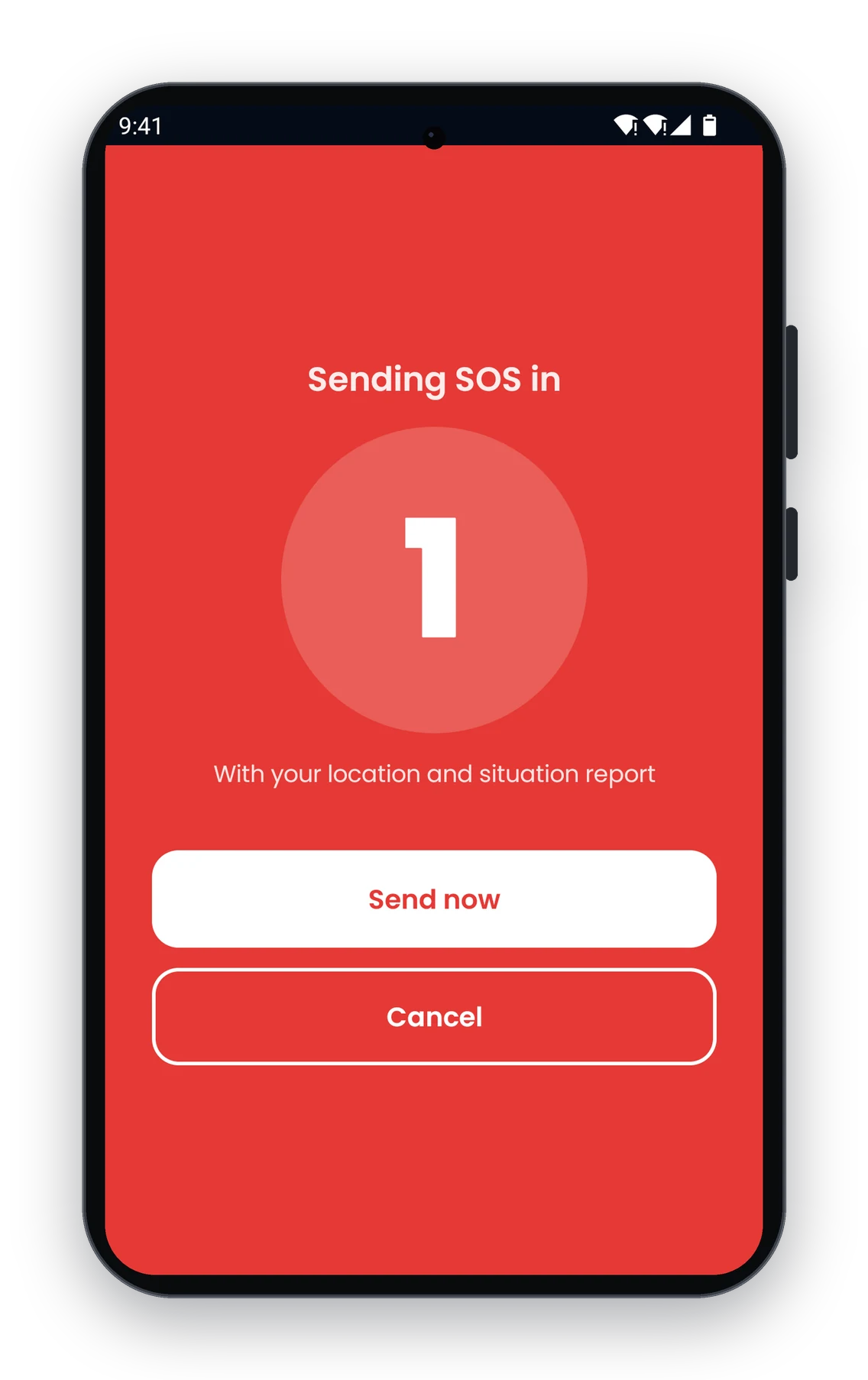
One-tap SOS with GPS and a situation report, scored 0–100 for urgency.
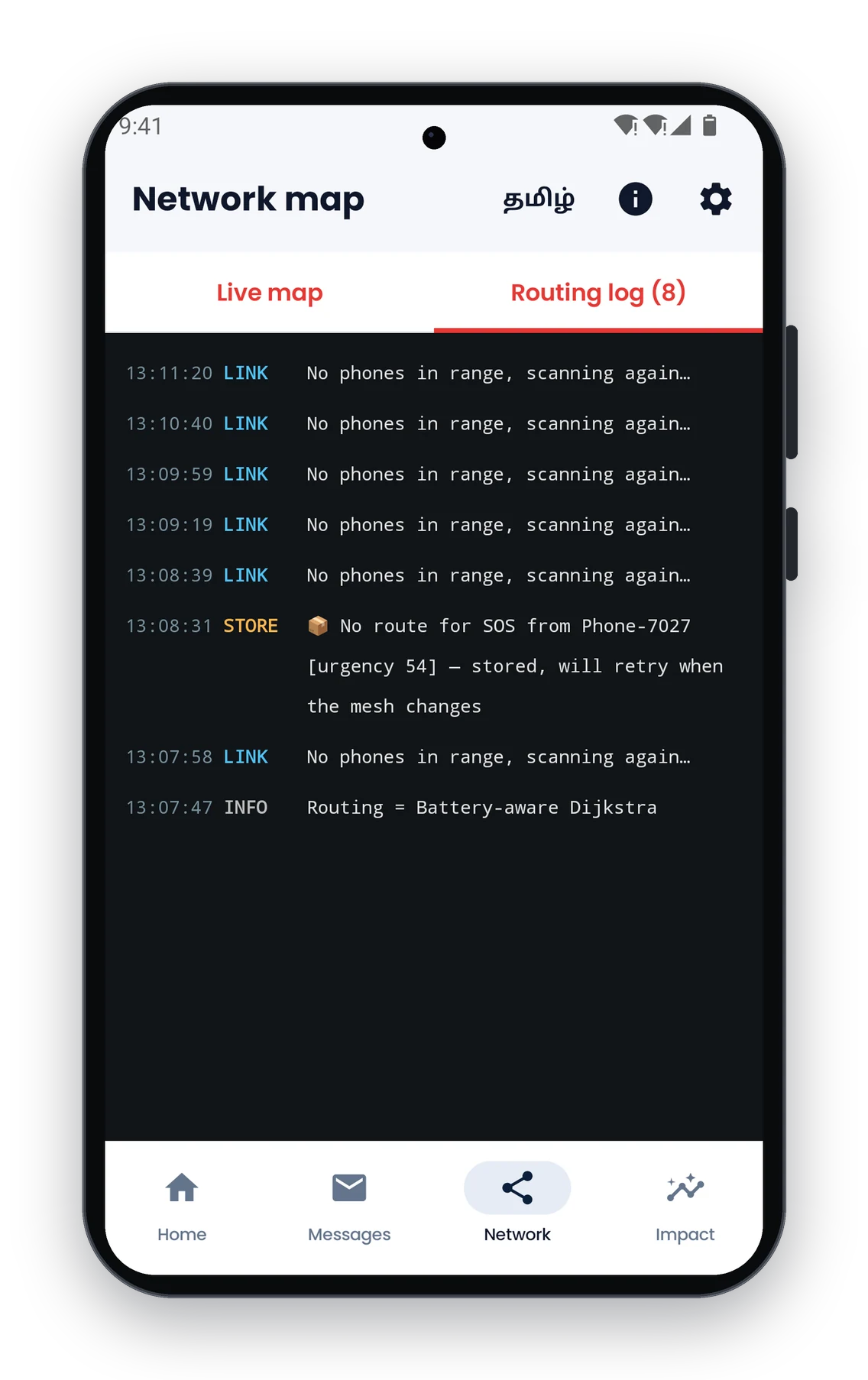
Bluetooth and Wi-Fi mesh with battery-aware routing. The most urgent SOS goes first.
Boats and NDRF teams carry stuck SOS out of areas with no signal.
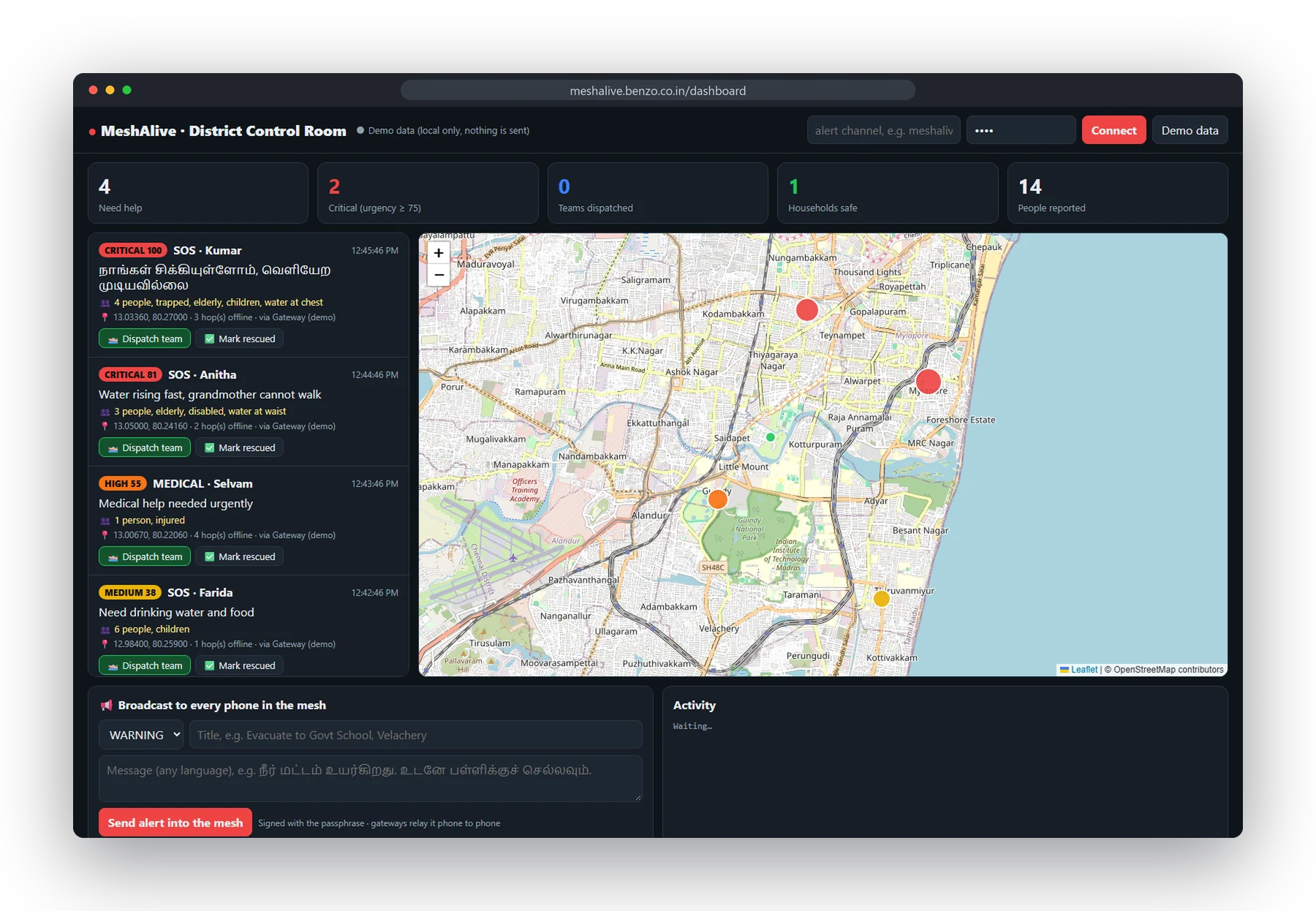
The first phone with signal uploads everything to a live, urgency-sorted map.
Dispatch and evacuation alerts travel back to phones with no signal.
Each household sets its situation once. Every SOS carries it, and the phone turns it into an urgency score, so the most critical families are reached first.
Phones relay for their neighbours over Bluetooth and Wi-Fi. When there is no route at all, rescue boats and teams carry the message out.
Runs in any browser on an existing control-room PC.
| Chat apps (Bridgefy, Briar) | LoRa radios (Meshtastic, goTenna) | MeshAlive | |
|---|---|---|---|
| Reaches rescuers | No | No | Live district dashboard |
| Help back to the victim | No | No | Dispatch and evacuation alerts |
| Prioritises urgent cases | No | No | Triage score 0–100 |
| No phone in range | Message waits | Message waits | Rescue carriers carry it out |
| Battery | Flooding drains phones | Flooding | Battery-aware routing |
| Extra hardware | None | ₹2,500+ per person | None |
| Language | English | English | Tamil and English |
A working Android app and control-room dashboard, measured with the app’s own routing engine.
Simulation of 200 phones and 20 SOS on the same network: Dijkstra 99 transmissions vs flooding 14,533; weakest phone 6.3% vs 3.2% battery left.
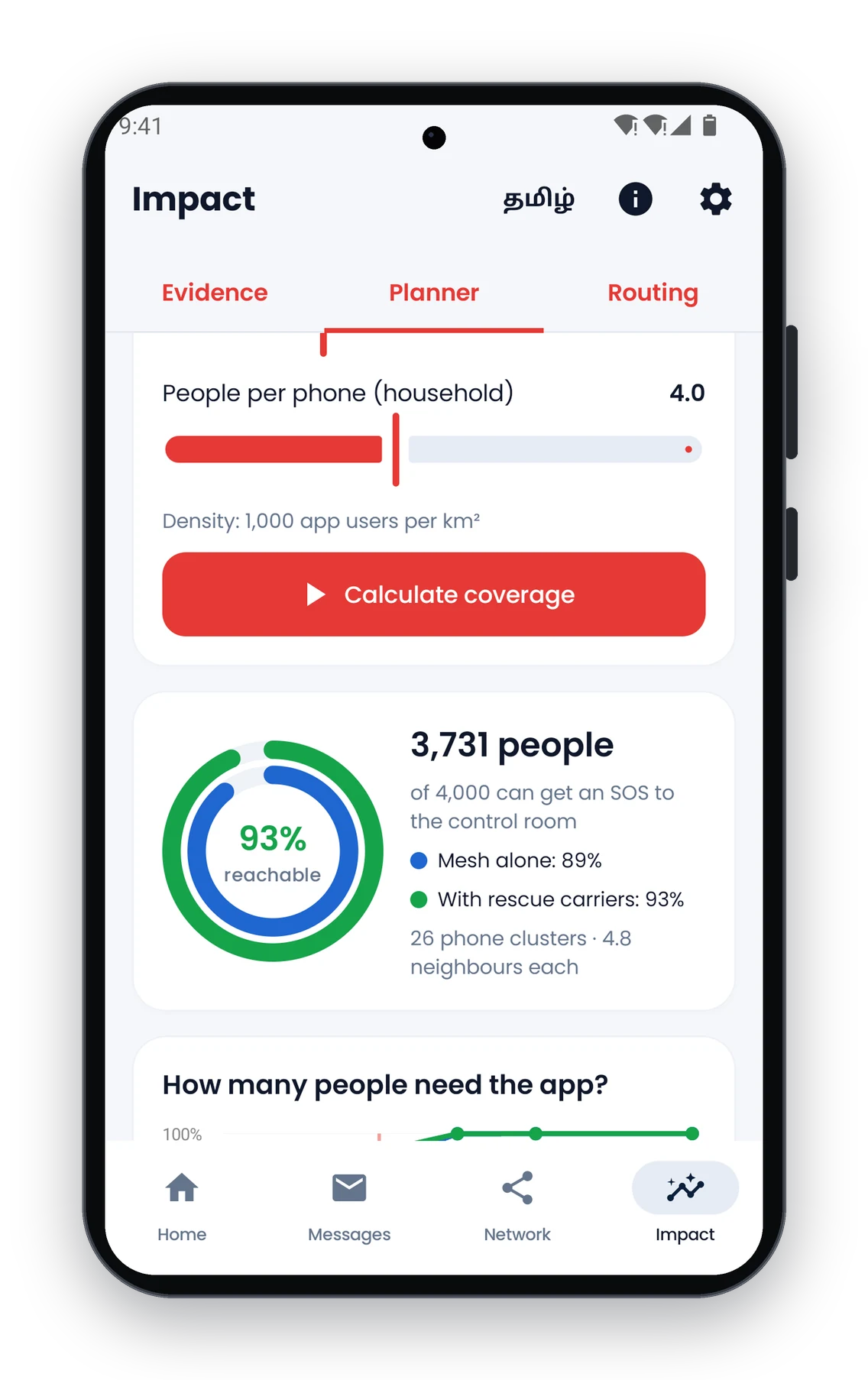
A built-in planner uses the same routing engine to show who can reach the control room, with and without rescue boats.
One flood-prone ward with the District Disaster Management Authority, local NDRF/SDRF boats as carriers, and the dashboard in the district EOC.
Pre-monsoon installation drives through schools, colleges, panchayats and urban local bodies.
Distribution through the SDMA, integration with state EOCs and the national Common Alerting Protocol, and more Indian languages.
MeshAlive has to be on the phone before the towers go down. It takes under a minute, and every install makes the mesh stronger for your whole street.

Scan with your phone camera to download
Those are chat apps between phones. MeshAlive is a response system: triage-scored SOS, battery-aware routing, rescue carriers, a district dashboard, and dispatch and evacuation messages back to people with no signal.
No. Phones talk directly over Bluetooth and Wi-Fi. Only one phone in the mesh, or a rescue carrier that reaches signal, needs internet to upload to the control room.
The SOS is stored and retried automatically, and rescue carriers pick it up and carry it out. The planner shows how many installs a ward needs.
No. Control-room commands are signed (HMAC-SHA256), and phones reject anything unsigned, altered or stale. Message text is encrypted on the phone.
₹0 in hardware for citizens, rescuers and the control room. The main cost is the district awareness and installation drive, run with the DDMA.
Install MeshAlive on your phone, or open the district control room with sample SOS data and dispatch a rescue team.